
Inman News / National Association of Realtors
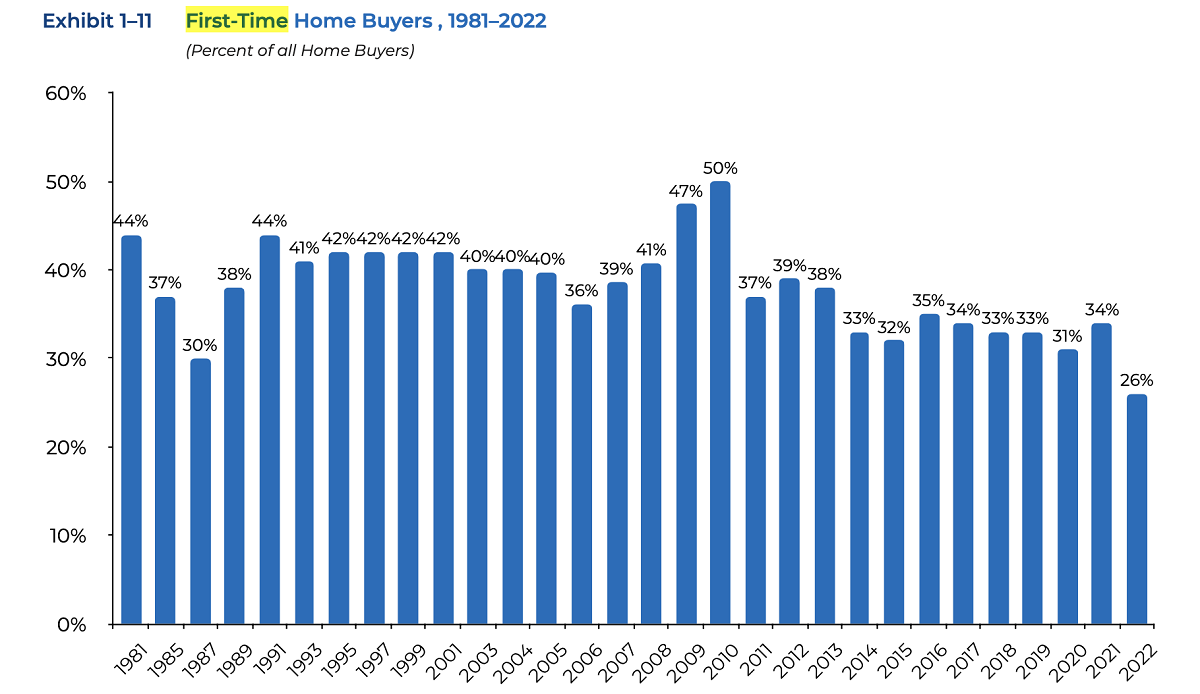
Rising home prices, mortgage rates and inflation cut the share of first-time buyers to 26% — the lowest level since the National Association of Realtors began surveying buyers and sellers in 1981.
Worsening affordability and increasing mortgage rates have taken their toll on first-time buyers, with their share of sales activity plunging to the lowest level since 1981 — the year the National Association of Realtors started publishing its annual Profile of Home Buyers and Sellers.
First-time buyers comprised 26 percent of home sales in 2022, down 8 percent from last year and falling 24 percent from the all-time high in 2010. The typical age for first-time buyers climbed three years to 36 years old, signaling the difficulty older Gen-Zers and younger millennials face while trying to break into the market.
“It’s not surprising that the share of first-time buyers shrank to the lowest level ever recorded given the housing market’s combination of historically low inventory, persistently high home prices and rapidly escalating interest rates,” NAR VP of Demographics and Behavioral Insight Jessica Lautz said of the survey results from 153,045 recent home buyers.
“Those who have housing equity hold the cards and they’ve fared very well in the current real estate market,” she added. “First-time buyers are older as a result of saving for down payments for longer periods of time or relying on a generational transfer of wealth to propel them into homeownership.”
Lautz said first-time buyers are making a growing number of sacrifices to become homeowners, including longer home search timelines (8 weeks vs 10 weeks), paying above asking price (28 percent), and moving to small and rural communities to find more affordable homes.
The median distance between the home that recent buyers purchased and the home from which they moved was 50 miles – a record high and 233 percent jump from the previous median of 15 miles.
As a result, the share of homes purchased in small towns (29 percent) and rural areas (19 percent) reached all-time highs while the share of homes purchased in suburban (39 percent) and urban (10 percent) areas declined annually.
“Family support systems still prevailed as a motivating factor when moving and in neighborhood choice,” Lautz said. “For others, housing affordability was a driving factor to seek homes in areas farther away. For many, remote work decisions were formalized in the last year, providing clarity for employees to permanently move to more distant areas.”
On a demographic level, Lautz said minorities had a more difficult time navigating quickly rising home prices, booming mortgage rates, inflation and other macroeconomic factors.
In 2022, 88 percent of first-time buyers were white, eight percent were Hispanic, three percent were Black and two percent were Asian. The shares of white and Hispanic buyers increased six percent and one percent from 2021, respectively, while the shares of Black and Asian buyers both declined by more than half.
“Housing affordability and limited inventory impacted the buying power of all buyers, however, the greatest impact was felt by Black and Asian Americans, as both groups saw a shrinking share of home buyers,” she explained. “Conversely, White and Hispanic Americans experienced gains in buyer shares.”
She added, “Population growth among Hispanic Americans likely drove the increase, while many white Americans are repeat buyers with housing equity that allows them to make easier trades in today’s market.”
Lautz said the market will continue to be tight, as evidenced by the increase in the average age of repeat buyers (56 years to 59 years) and homeownership tenure (10 years to 18 years).
NAR President Leslie Rouda Smith said the survey results prove there’s still plenty of opportunity for Realtors to step up and help consumers navigate an unpredictable market, as more than three-fourths of buyers (86 percent) and sellers (87 percent) chose to work with an agent this year.
“During challenging and changing market conditions, one thing that’s calming and constant is the assurance that comes from a Realtor being in your corner through every step of the home transaction,” Rouda Smith said in a statement on Thursday. “Consumers can rely on Realtors’ unmatched work ethic, trusted guidance and objectivity to help manage the complexities associated with the home buying and selling process.”
~~~~~~~~~~~~~~~~~~~~~~~~~~~~~~~~~~~~~~~~~~~~~~~~~~~~~~~~~~~~~~~~~~~~~~~~~~~~~~~~~~~~~~~~~~~~~~~~~~~~~~~
As the housing market surged last year, a typically large segment of home buyers went missing. Amid higher home prices, bidding wars and fierce competition for limited inventory, first-time home buyers dropped to their lowest numbers on record, according to the National Association of REALTORS®’ 2022 Profile of Home Buyers and Sellers. Further, the age of the typical first-timer swelled to a record high of 36, NAR data shows.
“It’s not surprising that the share of first-time buyers shrank to the lowest level ever recorded given the housing market’s combination of historically low inventory, persistently high home prices and rapidly escalating interest rates,” says Jessica Lautz, NAR’s vice president of demographics and behavioral insights. “Those who have housing equity hold the cards, and they’ve fared very well in the current real estate market. First-time buyers are older as a result of saving for down payments for longer periods of time or relying on a generational transfer of wealth to propel them into homeownership.”
First-time buyers comprised just 26% of all buyers in 2022, down from 34% the year before. That’s also nearly half of the 50% peak share first-timers reached in 2010, which was mostly triggered by the First-Time Home Buyer Tax Credit. “Since 2011, the share of first-time home buyers has been under the historical norm of 40% as buyers face tight inventory, rising home prices, rising rents and high student debt loads,” NAR’s report notes.
Forgetting the Starter Home
Faced with surging rents over the past year, first-time buyers are struggling to save enough to afford a home. For example, 92% of first-timers recently surveyed by ConsumerAffairs.com say they cannot afford a mortgage in the current market. Nearly 63% of all consumers say they’re willing to move to a state with a cheaper cost of living in order to afford a home, the survey shows.
Saving for a down payment is the biggest obstacle to homeownership that first-time home buyers cite, and they’re looking for financial help. Twenty-two percent of first-time buyers have used a gift or loan from friends and family to come up with a down payment, according to the NAR study. The typical down payment for first-time buyers was 6% in 2022 compared to 17% for repeat buyers.
Further, the idea of a “starter home” is becoming less practical as more first-time buyers say they intend to stay a long period of time in the property they buy. The median expected home tenure for first-time buyers has risen to a record high of 18 years, up from 10 years in 2021, according to NAR.
First-time home buyers also are pooling resources to afford homeownership. Notably, 15% purchased a multigenerational home over the past year to accommodate aging parents, grandparents or adult siblings, according to NAR’s survey. That is slightly higher than repeat buyers (14%). The biggest reason first-time buyers cite for purchasing a multigenerational home was wanting “a larger home that multiple incomes could afford together” (28%) and for “cost savings” (28%).