
CALCULATEDRISK
By Bill McBride
Construction of new U.S. homes rose 6.2% in December, to the highest level since July, increasing to 1.404 million Annual Rate
Note: The Census Bureau is still catching up. They released Start data for November and December today, but we are still missing January data.
From the Census Bureau: Permits, Starts and Completions
Housing Starts:
Privately-owned housing starts in December were at a seasonally adjusted annual rate of 1,404,000. This is 6.2 percent above the revised November estimate of 1,322,000, but is 7.3 percent below the December 2024 rate of 1,514,000. Single-family housing starts in December were at a rate of 981,000; this is 4.1 percent above the revised November figure of 942,000. The December rate for units in buildings with five units or more was 402,000.Privately-owned housing starts in November were at a seasonally adjusted annual rate of 1,322,000. This is 3.9 percent above the revised October estimate of 1,272,000.
An estimated 1,358,700 housing units were started in 2025. This is 0.6 percent below the 2024 figure of 1,367,100.
Building Permits:
Privately-owned housing units authorized by building permits in December were at a seasonally adjusted annual rate of 1,448,000. This is 4.3 percent above the revised November rate of 1,388,000, but is 2.2 percent below the December 2024 rate of 1,480,000. Single-family authorizations in December were at a rate of 881,000; this is 1.7 percent below the revised November figure of 896,000. Authorizations of units in buildings with five units or more were at a rate of 515,000 in December.Privately-owned housing units authorized by building permits in November were at a seasonally adjusted annual rate of 1,388,000. This is 1.6 percent below the revised October rate of 1,411,000.
An estimated 1,425,200 housing units were authorized by building permits in 2025. This is 3.6 percent below the 2024 figure of 1,478,000.
emphasis added
The first graph shows single and multi-family housing starts since 2000 (including housing bubble).
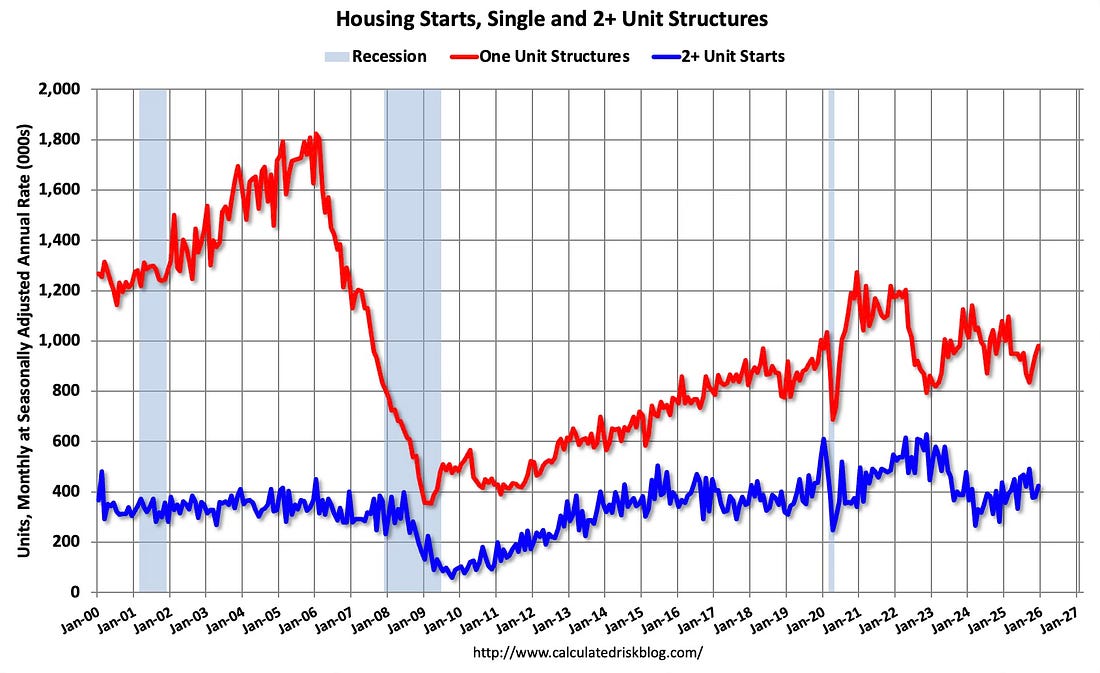
Multi-family starts (blue, 2+ units) increased month-over-month in December. Multi-family starts were down 1.0% year-over-year in December. Single-family starts (red) increased in December and were down 9.0% year-over-year.
The second graph shows single and multi-family starts since 1968.
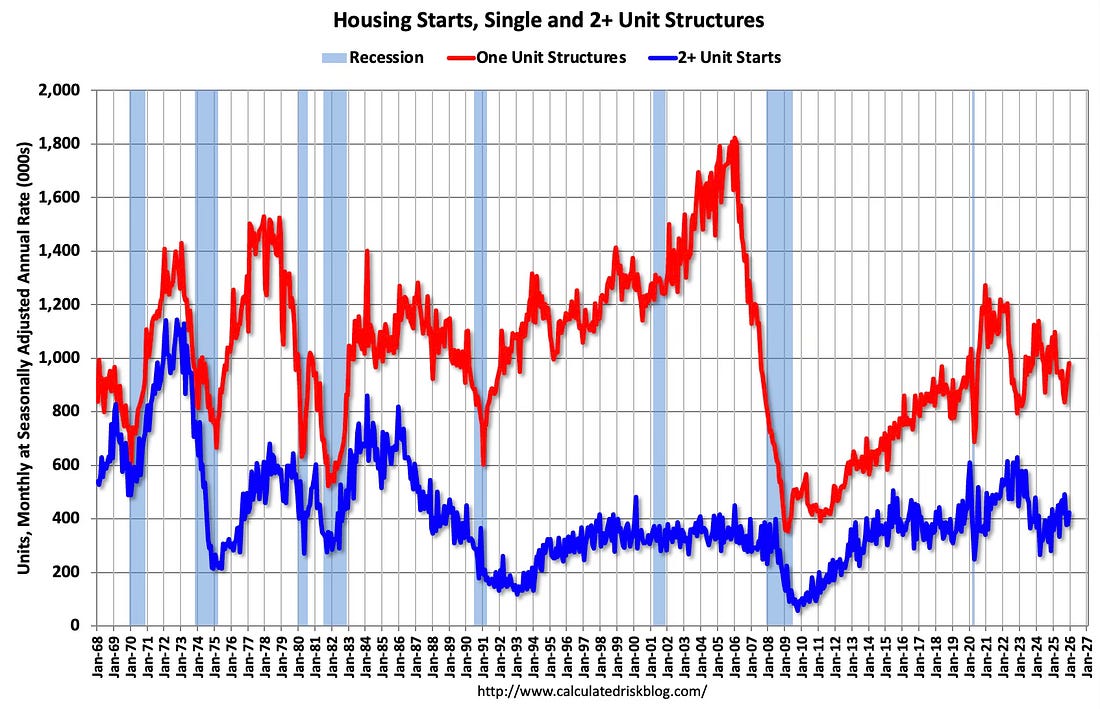
Total housing starts in December were above expectations.
The third graph shows the month-to-month comparison for total starts between 2024 (blue) and 2025 (red).
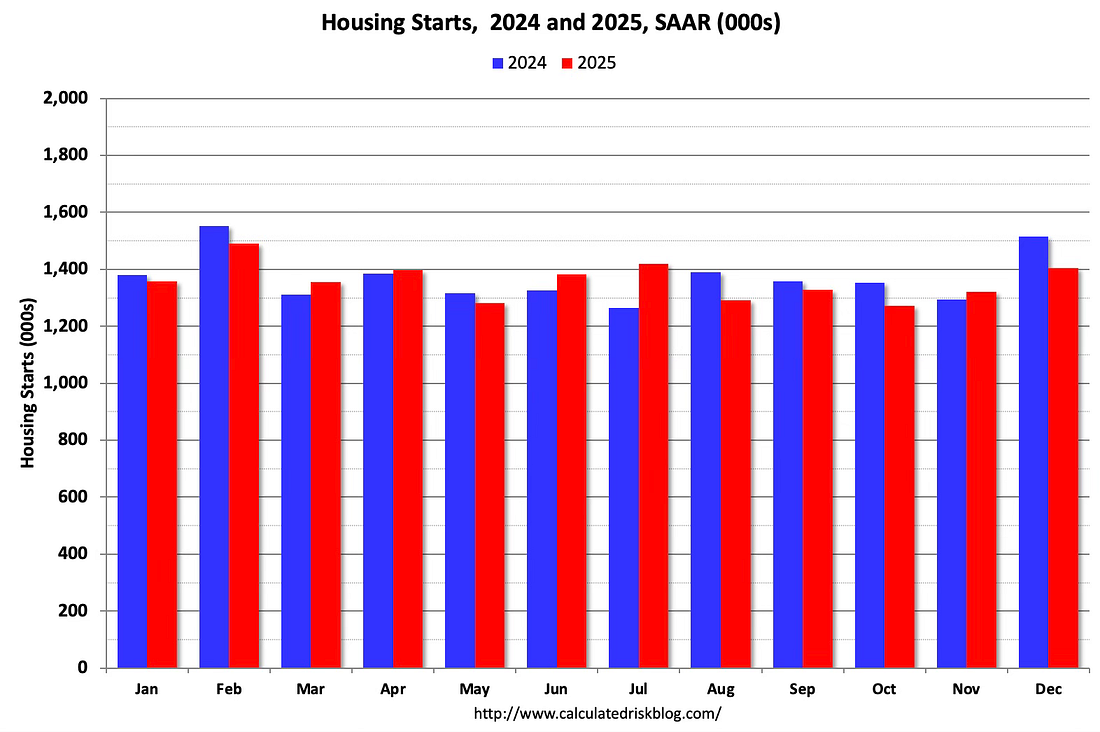
Total starts were down 7.3% in December compared to December 2024.
In 2025, starts were down 0.6% compared to 2024. Single family starts were down 6.9% and multi-family up 18.0% in 2025 compared to 2024.
Housing Units Under Construction Remains Elevated
The fourth graph shows housing starts under construction, Seasonally Adjusted (SA).
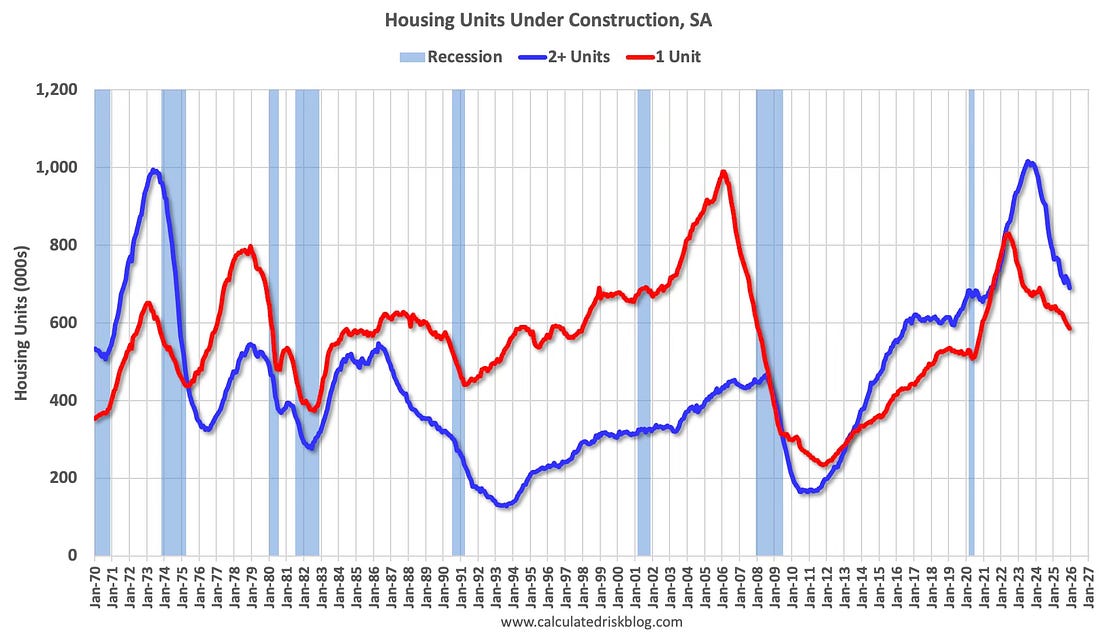
Currently there are 587 thousand single family units (red) under construction (SA). This was down in December compared to November, and 243 thousand below the pandemic peak in June 2022.
Currently there are 690 thousand multi-family units (blue) under construction. This was down from 706 thousand in November. This is 326 thousand below the record set in July 2023 of 1,016 thousand.
Combined, there are 1.277 million units under construction, 438 thousand below the all-time record of 1.715 million set in October 2022.
In the three years prior to the pandemic, there were about 1.1 to 1.2 million housing units under construction – so the current level is still a little elevated.
Comparing Starts and Completions
Below is a graph comparing multi-family starts and completions. Since it usually takes over a year on average to complete a multi-family project, there is a lag between multi-family starts and completions. Completions are important because that is new supply added to the market and starts are important because that is future new supply (units under construction is also important for employment).
These graphs use a 12-month rolling total for NSA starts and completions.
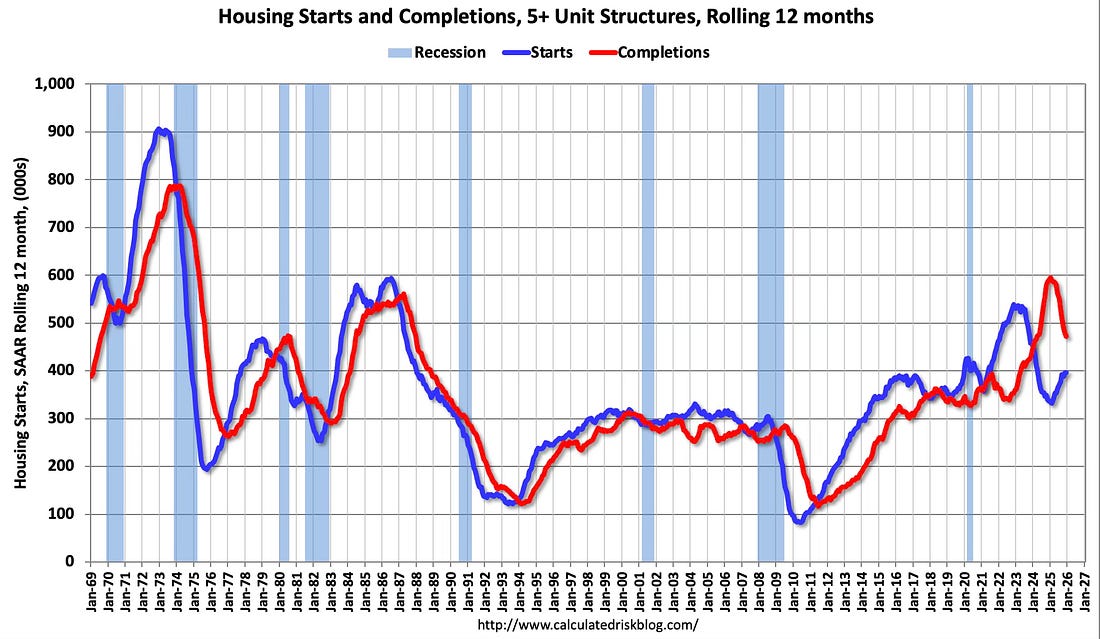
The blue line is for multifamily starts and the red line is for multifamily completions. Builders have been completing many more multifamily housing units than they have started on a 12-month basis. Multifamily starts have bottomed on a rolling 12-month basis, and completions have topped.
The last graph shows single family starts and completions. It usually only takes about 6 months between starting a single-family home and completion – so the lines are much closer than for multi-family. The blue line is for single family starts and the red line is for single family completions.
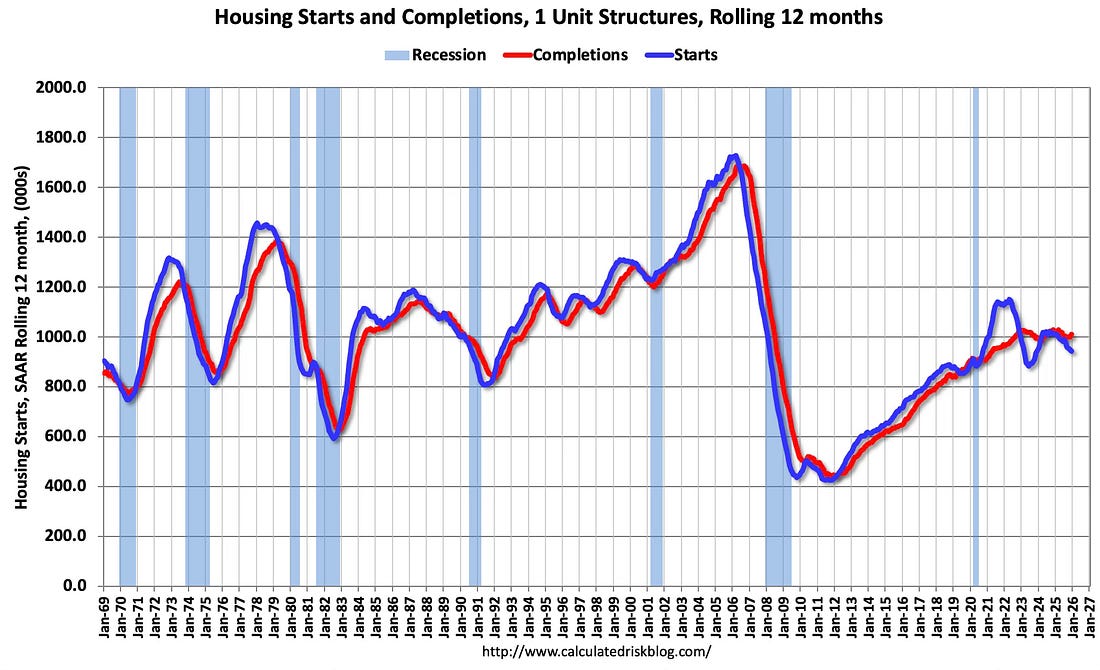
Builders are now starting about the same number of single-family homes as they are completing on a 12-month basis. Both starts and completions are trending down.
Conclusions
Total housing starts in December were above expectations.
Demand weakened in 2025 and this held down single family starts last year. However, somewhat lower mortgage rates in 2026 will help.
For multi-family, I’ve been watching leading indicators, such as the National Multifamily Housing Council’s (NMHC’s) Quarterly Survey of Apartment Market Conditions and the Architectural Billings Index (ABI) for signs of a pickup in the multi-family sector. The NMHC survey noted that the apartment market softened in Q4.
The Market Tightness Index (32) came in below the breakeven level of 50, indicating lower rent growth and higher vacancies for the second consecutive quarter.
Meanwhile the ABI for multi-family has been negative for the last 41 months. This suggests the recent pickup in multi-family starts might not last.