
CALCULATEDRISK
By Bill McBride
In Part 1: Current State of the Housing Market; Overview for mid-November 2025 I reviewed home inventory and sales. I noted that the key stories this year for existing homes are that inventory increased sharply, and sales are down slightly year-to-date compared to last year (and sales in 2024 were the lowest since 1995). That means prices are under pressure.
In Part 2, I will look at house prices, mortgage rates, rents and more.
As I noted in September, the house price trend suggests house prices will be down year-over-year by the end of 2025. However, there are two powerful forces pushing in opposite directions – mortgage rates have declined, and unemployment is increasing. Both could impact sales and house prices.
House Prices
The Case-Shiller National Index increased 1.5% year-over-year (YoY) in August and will likely be about the same year-over-year in the September report compared to August (based on other data).
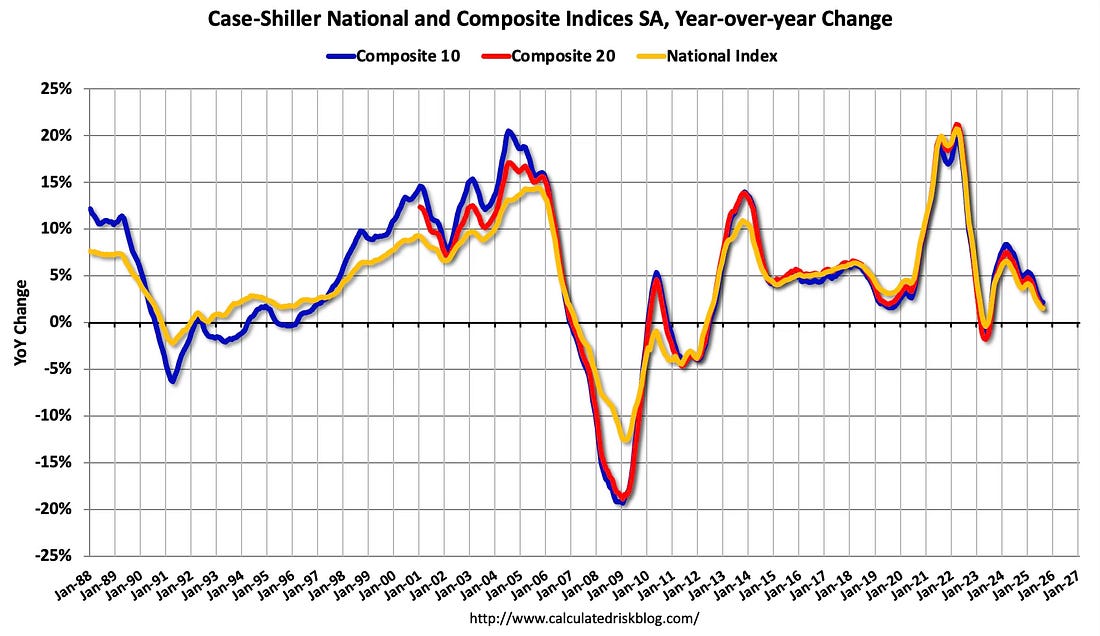
The Composite 10 NSA was up 2.1% year-over-year. The Composite 20 NSA was up 1.6% year-over-year. The National index NSA was up 1.5% year-over-year.
The MoM increase in the seasonally adjusted (SA) Case-Shiller National Index was at 0.21% (a +2.5% annual rate). This followed five consecutive MoM decreases in the seasonally adjusted index.
In the January report, the Case-Shiller National index was up 4.2%, in February up 3.9%, in March up 3.4%, in April report up 2.7%, in May up 2.3%, in June up 1.9% in July 1.7% and in August 1.5%.
And the August Case-Shiller index was a 3-month average of closing prices in June, July and August. June closing prices include some contracts signed in April.
So, not only is this trending down, but there is a significant lag to this data.
Let’s review some more timely house price data …
Other measures of house prices suggest prices will be up about the same YoY in the September Case-Shiller index as in the August report. The NAR reported median prices were up 2.1% YoY in September, up from 2.0% YoY in August. (Note that median prices are impacted by the mix).
ICE reported prices were up 0.9% YoY in October. Freddie Mac reported house prices were up 1.0% YoY in September, down from 1.3% YoY in August.
Here is a comparison of year-over-year change in the FMHPI, median house prices from the NAR, and the Case-Shiller National index.
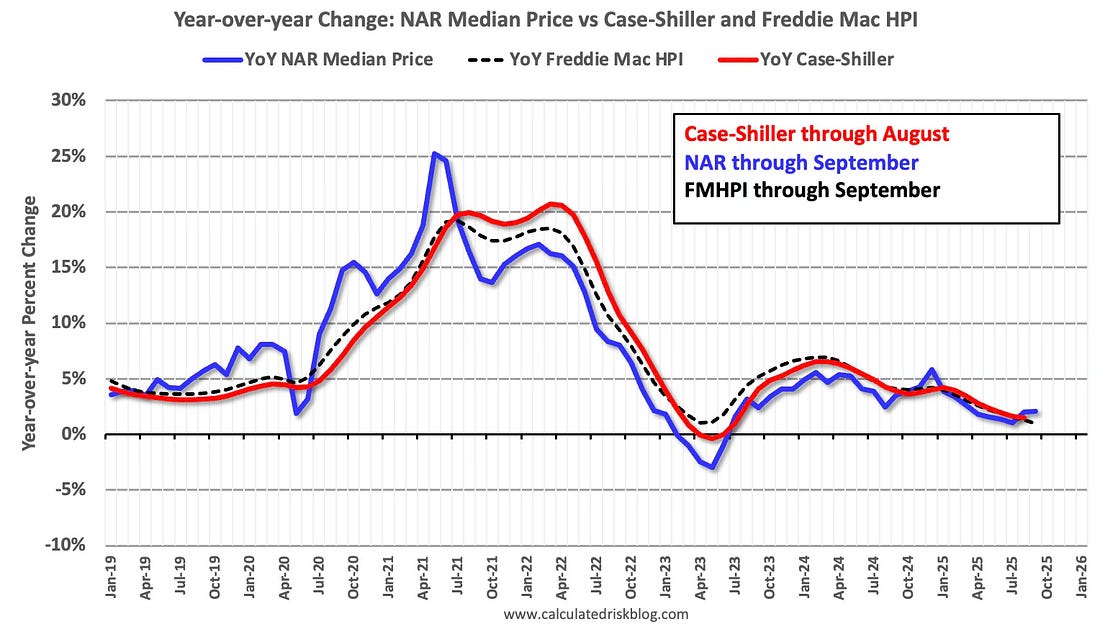
The FMHPI is suggesting the Case-Shiller index will likely be up about the same year-over-year in the September report compared to August.
In real terms, the Case-Shiller National index is down 2.8% from the peak in 2022, seasonally adjusted. It has now been 38 months since the real peak in house prices. Typically, after a sharp increase in prices, it takes a number of years for real prices to reach new highs.
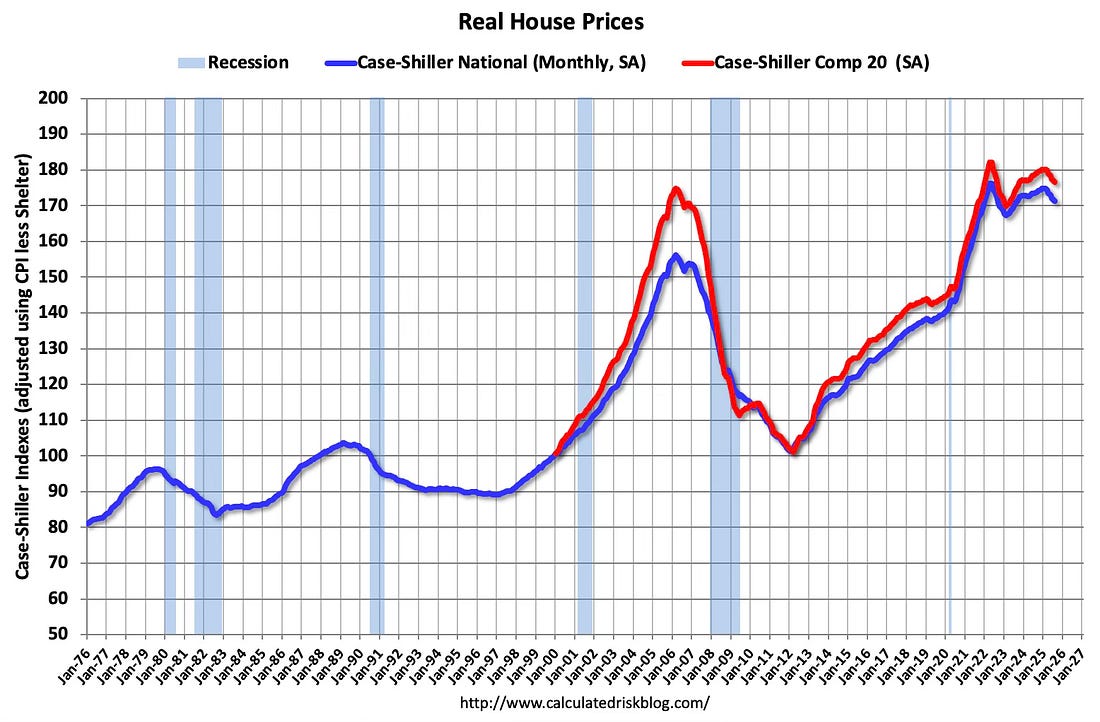
Both the real National index and the Comp-20 index decreased in August. The real National index has decreased for 8 consecutive months.
30-Year Mortgage Rates Near Low End of 3-Year Range
The following graph from MortgageNewsDaily.com shows mortgage rates since January 1, 2000. 30-year mortgage rates were at 6.29% on November 12th. This is slightly above the recent lows, but near the low of the range for the last 3 years.
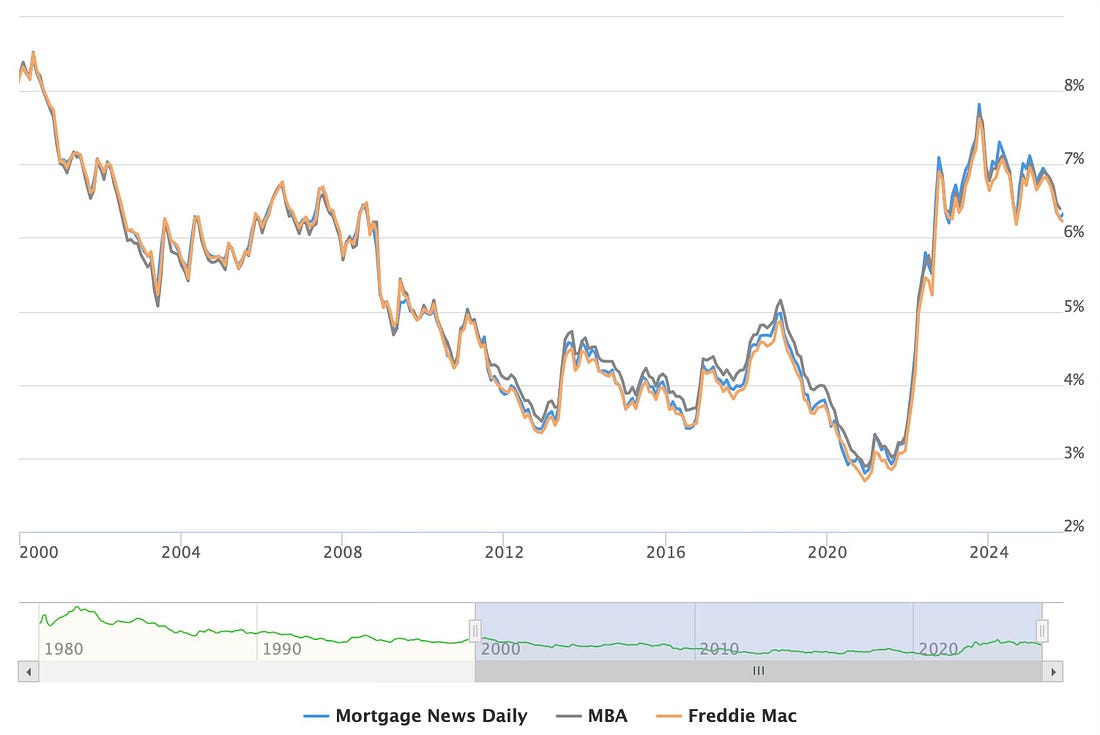
Mortgage rates were low following the financial crisis through the early years of the pandemic. Now rates have returned to a new normal in 30-year mortgage rates in the 6% to 7% range.
A year ago, 30-year mortgage rates were at 7.02%, two years ago rates were at 7.58%, three years ago rates at 6.65%, and four years ago at 3.23%.
It is financially very difficult for homeowners to move and give up their 3% mortgage rates, however time and life changes are slowing leading to more listings.
Mortgage Purchase Applications Have Increased
Here is a graph showing the MBA mortgage purchase index released this week. Purchase application activity is up from the lows in late October 2023 and is above the lowest levels during the housing bust.
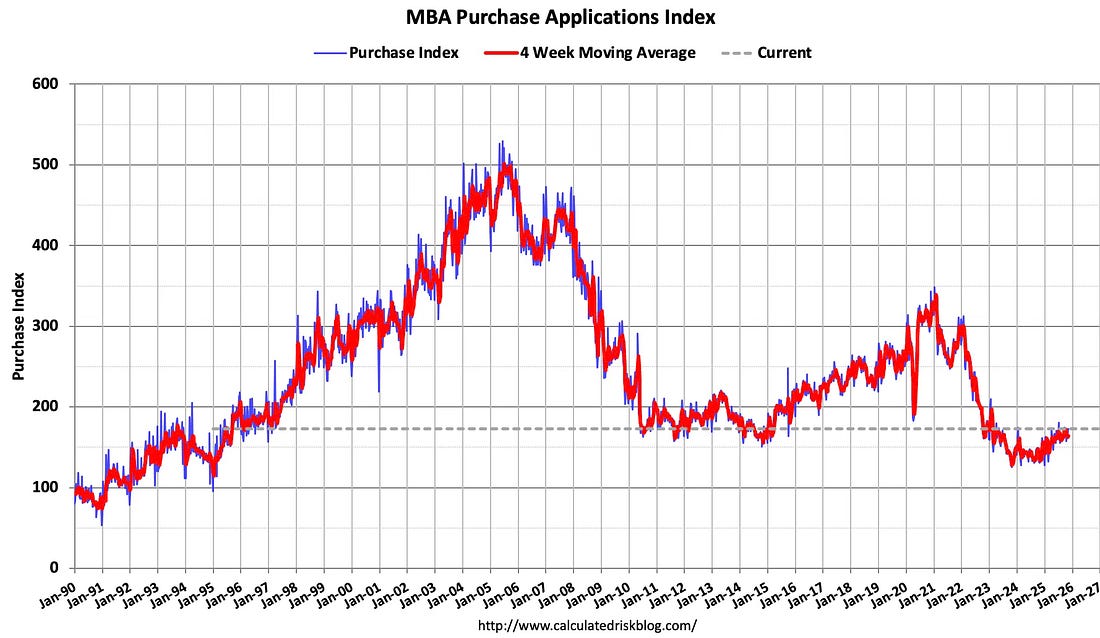
This is still very low, but increasing.
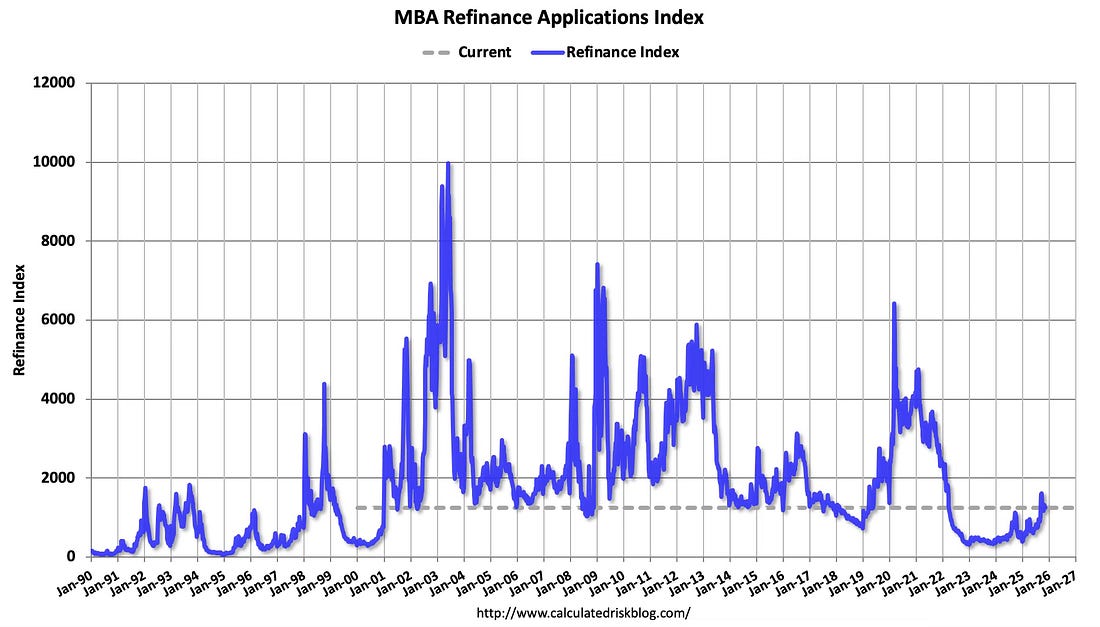
And the next graph shows the refinance index since 1990. Refinance activity is still very low but picking up a little with lower mortgage rates.
Many of the homebuyers in the last few years might be able to refinance now.
Asking Rents Mostly Unchanged Year-over-year
Here is a graph of the year-over-year (YoY) change for these measures since January 2015. Most of these measures are through September 2025, except Apartment List through October 2025.
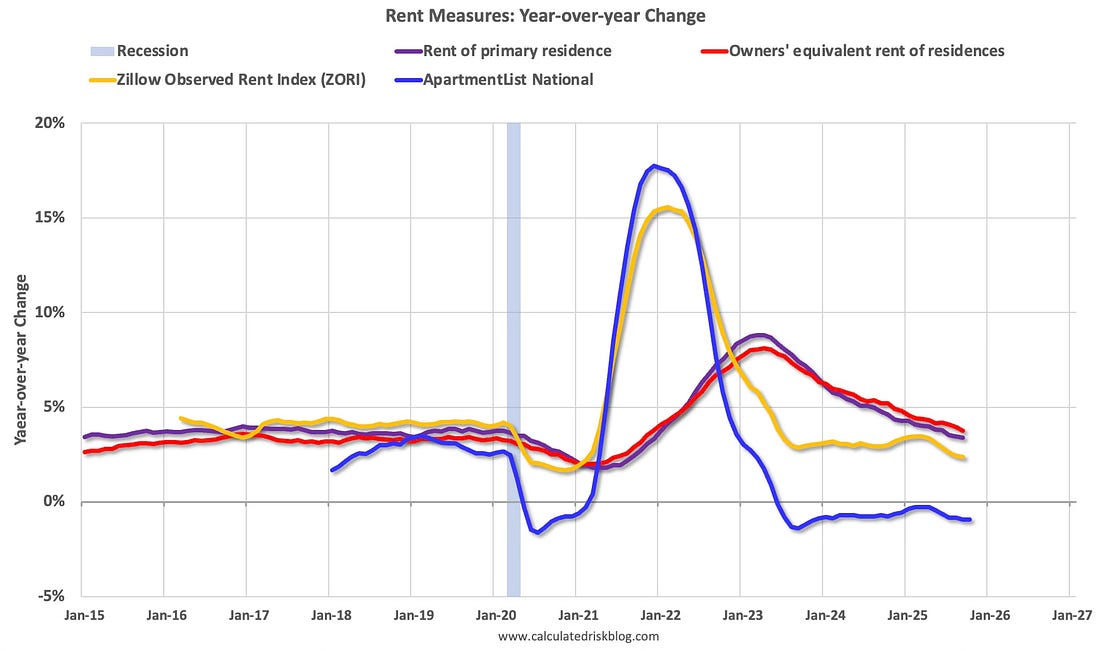
The Zillow measure (single and multi-family) is up 2.3% YoY in September, down from 2.4% YoY inAugust, and down from a peak of 15.6% YoY in February 2022.
The ApartmentList measure is -0.9% YoY as of October, down slightly from -0.9% in September, and down from a peak of 17.8% YoY December 2021.
Asking rents are mostly unchanged YoY for multi-family and with new supply coming on the market (although at a lower level than last year), we will likely see continued pressure on asking rents. It is possible that policy (less immigration, more deportations) could also put downward pressure on rents.
Current Outstanding Mortgage Rates
Here is some data showing the distribution of interest rates on closed-end, fixed-rate 1-4 family mortgages outstanding at the end of each quarter since Q1 2013 through Q2 2025.

This shows the surge in the percent of loans under 3% starting in early 2020 as mortgage rates declined sharply during the pandemic.
Note that a fairly large percentage of mortgage loans were under 4% prior to the pandemic!
The percent of outstanding loans under 4% peaked in Q1 2022 at 65.1% (now at 52.5%), and the percent under 5% peaked at 85.6% (now at 70.4%). These low existing mortgage rates made it difficult for homeowners to sell their homes and buy a new home since their monthly payments would increase sharply.
This was a key reason existing home inventory levels were so low. However, time is eroding this lock-in effect.
The percent of loans over 6% bottomed in Q2 2022 at 7.3% and has increased to 19.7% in Q2 2025.